
Most of the antibody medicines that changed cancer care over the past two decades work from the outside of a cell. They bind a protein on the surface, block a signal, or deliver a payload to a receptor sitting where a large protein can reach it. That design has produced real therapies. It has also left important targets on the other side of the membrane, including proteins that live in the cytoplasm or the nucleus.
One of those proteins is p53, often described as a guardian of the genome. When it works, damaged cells are more likely to pause, repair, or die in an orderly way. When the gene behind it is mutated, that brake fails. Mutations in TP53 are common across solid tumors and especially frequent in aggressive subtypes such as triple-negative breast cancer (TNBC). Restoring that function has been a research goal for decades. In 2026, a quieter class of biologics — nanobodies — is being tested as a way to get a designed protein inside a cancer cell and try.
Why triple-negative breast cancer still needs new tools
Breast cancer remains one of the most common cancers in women worldwide. According to the World Health Organization, an estimated 2.4 million women were diagnosed in 2024, and about 694,000 people died of the disease that year. Those figures describe breast cancer as a whole. They do not describe one subtype, and they should not be read as a claim about any experimental drug.
Triple-negative breast cancer is a smaller slice of that burden and a harder one to treat with targeted medicines. “Triple-negative” means the tumor does not express estrogen receptor, progesterone receptor, or HER2 — the three markers that many existing therapies use as a handle. Surgery, chemotherapy, radiation, immunotherapy, and, in selected patients, PARP inhibitors remain the backbone of care. For many people those tools help. The remaining problem is well known to oncologists: fewer targeted options, a tendency toward aggressive growth, and, often, a biology that includes a damaged p53 pathway.
That last point is why intracellular biologics keep circling back to TNBC. Mutant p53 is a plausible vulnerability and a difficult target, because the protein sits inside the cell rather than on the surface where a conventional monoclonal antibody can dock.
Nanobodies are not just smaller antibodies
A typical monoclonal antibody is a large, Y-shaped protein, on the order of 150 kilodaltons. Nanobodies, also called VHH fragments, come from a family of heavy-chain-only antibodies found in camelids such as llamas and camels. After isolation and, in therapeutic programs, humanization so the sequence is closer to a human protein, the binding domain is roughly a tenth that size — about 12 to 15 kilodaltons.
Size is a physical constraint, not a slogan. Large antibodies occupy extracellular space well and cross into the interior of a cell poorly. Compact binders can, in principle, reach recessed epitopes, move through tissue more readily, and, if they are taken up by the cell, engage proteins that live in the cytoplasm or nucleus. They can also be produced as a single polypeptide rather than a multi-chain assembly held together by chemical linkers.
None of that makes a nanobody a better drug by default. Smaller proteins are often cleared faster by the kidney, and getting inside a cell is still a separate engineering problem. What the size difference does is open a door that full-size antibodies generally cannot walk through.
An intracellular bet on mutant p53
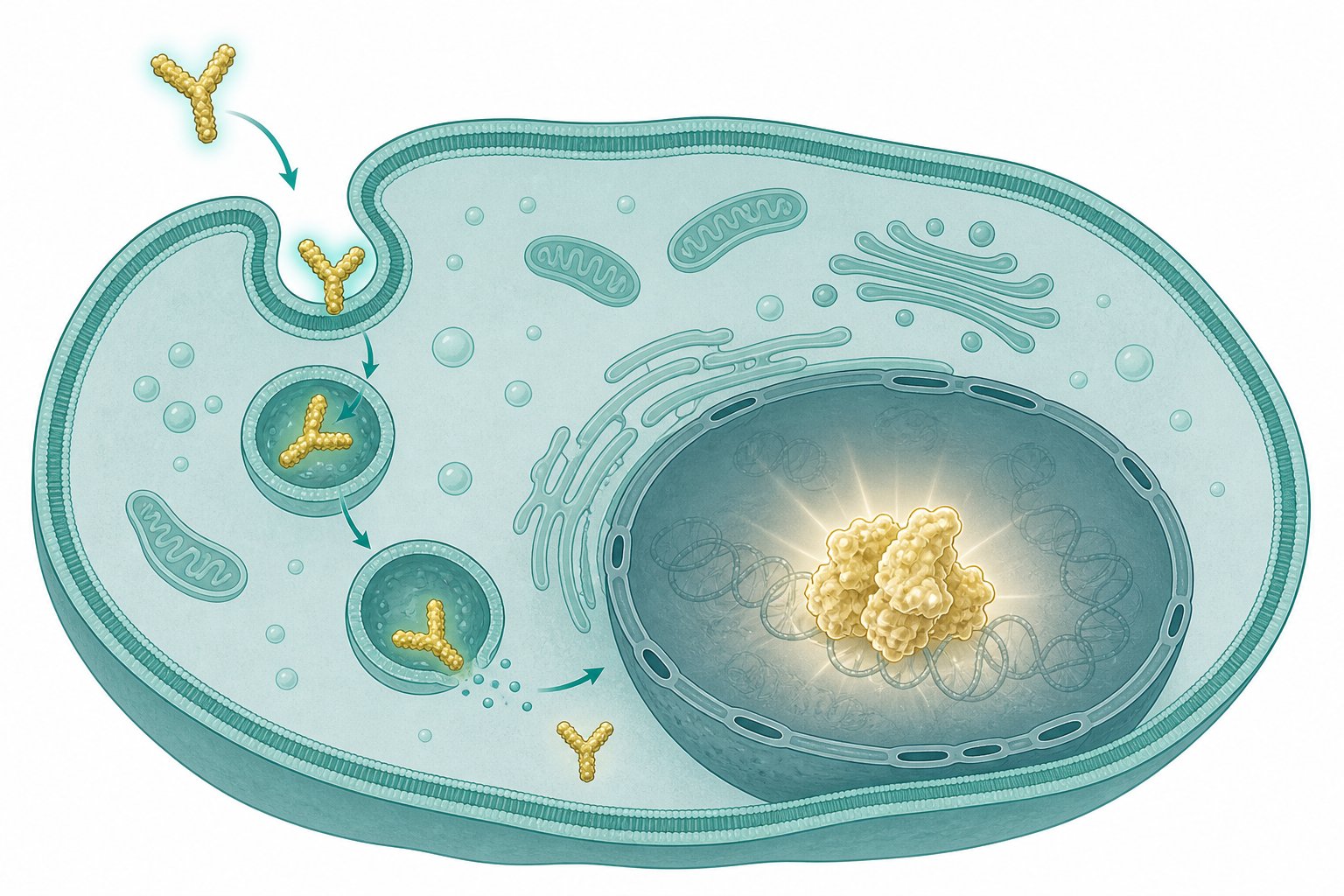
p53 is not a surface receptor. To affect it with a protein drug, the molecule has to enter the cell, survive trafficking, and then restore enough function in a mutant protein to matter. One proposed route is endocytosis: the cell’s own habit of folding a bit of membrane inward and swallowing material in a vesicle. If a nanobody can ride that process, reach the right compartment, and stabilize or reactivate mutant p53, the hoped-for outcome is apoptosis — programmed death of the damaged cell.
That sequence is easy to overstate. Endocytosis is a normal cellular process, not a guaranteed delivery service. Reactivating a misfolded or mutated protein is one of the harder problems in oncology, because the protein’s shape and partners may already be wrong. The work belongs in laboratories and model systems until a regulator has reviewed human data. In 2026, that is still where most of this science sits.
In that early setting, a U.S. company based in Southlake, Texas, is developing an intracellular nanobody intended to reactivate mutant p53. PHP Biotech lists as its lead candidate PHP53-nb, a patented humanized nanobody designed to enter cells through endocytosis, restore p53-related function, and push tumor cells toward apoptosis. The company describes the molecule as a single biological agent without chemical linkers, rather than a conventional antibody-drug conjugate.
What the model-system data actually show
PHP Biotech reports that PHP53-nb reduced cell viability in a dose-dependent manner in both triple-negative breast cancer and ovarian tumor cell models. Dose-dependent means that, in those experiments, more of the candidate corresponded with fewer viable tumor cells. That is a useful laboratory signal. It is not a survival result, a safety profile, or evidence that the same thing would happen in a person.
PHP53-nb is not an FDA-approved drug. It is not in clinical trials based on the company’s publicly described pipeline as of 2026. The program remains in research and model systems. Plans to finish preclinical studies and, if the data support it, move toward first-in-human testing are plans, not a treatment option.
Cell models cannot capture a patient’s immune system, liver metabolism, or tumor microenvironment. Animal studies can show where a molecule goes; they cannot tell you whether a person will benefit, at what dose, or with what side effects. Laboratory reductions in cell viability are a reason to keep studying a candidate. They are not a reason to change anyone’s care.
How to read this kind of science in 2026
Cancer headlines tend to collapse three different questions into one. Is the biology interesting? Has a specific candidate shown a signal in a controlled model? Has anyone demonstrated safety and benefit in people? For nanobody programs aimed at intracellular p53, the honest answers in 2026 are yes, in some laboratories yes, and no.
This is oncology discovery work, not a wellness protocol and not a supplement. Nothing in the published company materials supports using PHP53-nb, or any similar nanobody, outside a regulated research setting. A practical way to keep watching the field is to ask the same questions of every announcement. Is the work still in cells and animals, or has a registered human study started? Is the company naming a specific candidate and a specific model, or using broad language about destroying cancer? If a human study ever begins, what is it measuring first — usually safety — and in which patients?
The bottom line
Nanobodies are smaller than full monoclonal antibodies, and that size difference is why researchers are testing them against intracellular targets that conventional biologics cannot easily reach. Mutant p53 is one of those targets. Triple-negative breast cancer is one of the diseases where that biology shows up often, and where targeted options remain limited.
PHP53-nb is an example of that research, not a finished medicine. It is a patented humanized nanobody being studied in tumor cell models, including TNBC and ovarian models. It has not been approved by the FDA, it is not a proven treatment, and it is not a cure.
This article is for educational purposes only and is not medical advice. It does not diagnose, treat, or recommend therapy. Anyone facing a cancer diagnosis, or caring for someone who is, should discuss questions about standard care and clinical trials with a qualified clinician who knows the case.